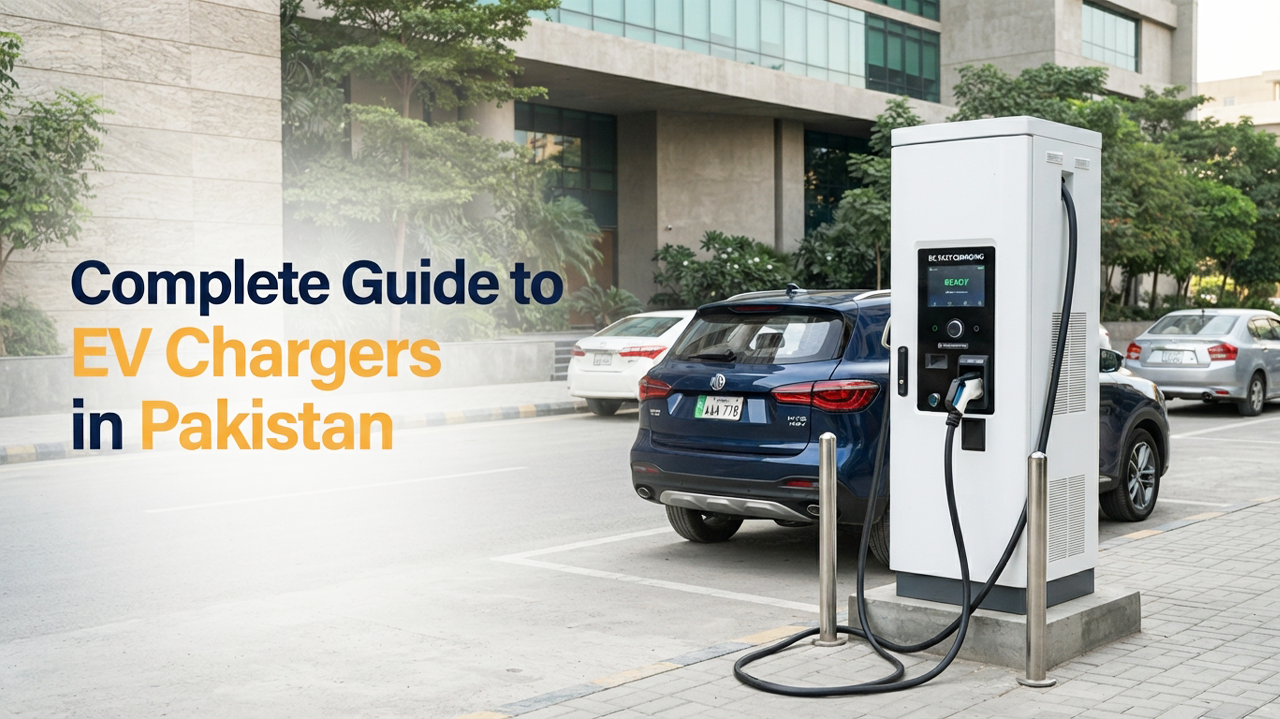
Electric mobility is moving from a future concept to a growing part of Pakistan's transportation and energy landscape. As more electric cars, bikes, buses, and commercial vehicles enter the market, the need for reliable and accessible EV charging infrastructure in Pakistan is becoming increasingly important.
Buying an electric vehicle is only one part of the transition. Drivers also need convenient places to charge, while businesses, property developers, fleet operators, fuel stations, hotels, shopping malls, and residential communities need dependable charging infrastructure to support the growing EV market.
This is where EV chargers come in.
An EV charger is the equipment that safely supplies electricity to an electric vehicle. Depending on the charger technology, electrical supply, vehicle battery, and charging capacity, charging can take anywhere from several hours to less than an hour.
Pakistan's policy environment is also evolving. The Ministry of Industries & Production lists the New Energy Vehicles Policy 2025–30 among its current policies, reflecting the country's broader push toward electric mobility.
For businesses considering EV charging infrastructure, this creates an opportunity to prepare for a transportation ecosystem that is increasingly connected to clean energy.
In this complete guide, we explain what EV chargers are, how they work, different types of EV chargers, charging speeds, connectors, applications, installation requirements, costs, benefits, challenges, and how to choose the right EV charging solution in Pakistan.
What Is an EV Charger?
An EV charger, or Electric Vehicle Charger, is a device that transfers electrical energy from an electricity source to the battery of an electric vehicle.
Just like a conventional vehicle needs fuel, an electric vehicle needs electrical energy. Instead of filling a fuel tank, an EV is connected to a charging system through a compatible charging connector.
Depending on the system, EV chargers can be installed at
- Homes
- Offices
- Shopping malls
- Hotels
- Restaurants
- Petrol stations
- Parking facilities
- Residential societies
- Industrial facilities
- Fleet depots
- Highways
- Public charging stations
EV charging infrastructure can range from a relatively simple AC charger for overnight charging to high-power DC fast-charging systems designed for commercial and highway applications.
How Do EV Chargers Work?
The basic process is straightforward:
Electricity Source ? EV Charger ? Charging Connector ? Vehicle Battery
However, the actual process involves communication and power-management systems.
Step 1: Power Supply
The charger receives electricity from the grid, building electrical system, or potentially a renewable energy source such as solar.
Step 2: Vehicle Connection
The driver connects the EV to the charger using a compatible connector.
Step 3: Communication
The vehicle and charger communicate with each other to determine the appropriate charging conditions.
Step 4: Power Delivery
The charger delivers electricity according to the vehicle's requirements and the charger's capabilities.
Step 5: Battery Management
The vehicle's Battery Management System (BMS) monitors battery conditions, temperature, voltage, and charging status.
Step 6: Charging Completion
When the battery reaches the desired state of charge, the system reduces or stops power delivery according to the vehicle's charging strategy.
This controlled process is essential because EV batteries require carefully regulated charging rather than simply receiving unrestricted electrical power.
AC vs DC EV Chargers
One of the most important concepts for anyone researching EV chargers in Pakistan is the difference between AC and DC charging.
AC EV Chargers
AC chargers supply alternating current to the vehicle.
The vehicle's onboard charger then converts AC electricity into DC electricity that can be stored in the battery.
AC chargers are commonly used for:
- Homes
- Offices
- Hotels
- Apartments
- Residential societies
- Workplace parking
They are generally suitable when a vehicle can remain parked for several hours.
Advantages of AC Chargers
- Suitable for overnight charging
- Lower infrastructure cost than high-power DC charging
- Practical for homes and workplaces
- Generally simpler electrical infrastructure
- Good for long-duration parking
DC Fast EV Chargers
DC fast chargers work differently.
They convert AC electricity to DC within the charging equipment and provide DC power directly to the vehicle battery, subject to the vehicle's charging system and limits.
This allows much faster charging than conventional AC charging.
DC fast chargers are particularly suitable for
- Highways
- Petrol stations
- Commercial charging hubs
- Shopping malls
- Fleet operations
- Service areas
- High-traffic locations
Charging time depends on the charger's output, vehicle battery capacity, battery temperature, state of charge, and the vehicle's maximum DC charging capability.
EV Charger Levels Explained
EV charging is often broadly categorized into different charging levels.
Level 1 Charging
Level 1 charging typically uses a standard low-power AC electrical supply.
It is suitable for:
- Emergency charging
- Low daily mileage
- Long overnight parking
However, it is generally too slow for high-utilization commercial applications.
Level 2 Charging
Level 2 charging uses higher-power AC charging equipment.
It is suitable for:
- Homes
- Offices
- Hotels
- Commercial buildings
- Residential developments
For many users, Level 2 provides a practical balance between installation cost and charging speed.
DC Fast Charging
DC fast charging significantly reduces charging time.
Depending on the vehicle and charger, commercial DC charging systems can range from tens of kilowatts to several hundred kilowatts.
High-power charging is particularly valuable where vehicles cannot remain parked for several hours.
Types of EV Chargers in Pakistan
The Pakistani market includes several EV charging configurations.
Home EV Chargers
Designed for residential users.
Typical applications include:
- Houses
- Garages
- Private parking spaces
The charger can be installed close to the vehicle parking area and used primarily overnight.
Commercial EV Chargers
Commercial charging stations are designed for:
- Offices
- Shopping malls
- Hotels
- Restaurants
- Corporate facilities
- Parking facilities
Businesses can offer charging as an additional customer service or develop charging as a dedicated revenue-generating service.
DC Fast Chargers
These are designed for situations where charging speed is a priority.
They are especially relevant to public charging infrastructure and highway networks.
Fleet Charging Systems
Fleet operators may require multiple charging points for
- Delivery vehicles
- Company cars
- Electric buses
- Taxis
- Logistics fleets
Fleet charging requires careful planning because multiple vehicles may need to charge simultaneously.
Solar-Powered EV Charging
EV chargers can also be integrated with solar energy systems.
A solar-powered EV charging solution can combine
Solar Panels + Inverter + Energy Management + EV Charger
Depending on system design, battery storage can also be integrated.
This approach is particularly attractive for businesses seeking to combine transportation electrification with renewable energy.
EV Charger Connectors
The connector is another important consideration when selecting an EV charger.
Different vehicles may use different charging standards.
Common connector types include:
Type 2
Commonly associated with AC charging applications.
CCS
Combined Charging System connectors support AC and DC charging depending on the configuration.
CHAdeMO
A DC charging standard that has been used by various vehicle manufacturers.
GB/T
A charging standard widely associated with Chinese EVs.
Because Pakistan's EV market includes vehicles from different manufacturers and markets, connector compatibility should be checked before purchasing or installing a charger.
Always verify the charging port and charging specifications of the specific vehicle before selecting charging equipment.
EV Charging Speed: What Determines It?
It is a common misconception that a 120 kW charger will always charge an EV at 120 kW.
Actual charging speed depends on several factors.
Charger Power
Higher-power chargers can potentially deliver more energy per unit of time.
Vehicle Maximum Charging Rate
The vehicle determines how much power it can accept.
Battery Capacity
A larger battery generally requires more energy to reach a particular state of charge.
State of Charge
Charging speed can decrease as the battery approaches a high state of charge.
Battery Temperature
Battery temperature can influence charging performance.
Electrical Infrastructure
The site's transformer, distribution equipment, protection systems, and available grid capacity must support the charger.
Therefore, selecting an EV charger should always involve matching the charger, vehicle, and electrical infrastructure.
Applications of EV Chargers in Pakistan
EV charging infrastructure has applications across multiple sectors.
Residential Properties
Home charging provides convenience for EV owners who can charge while parked overnight.
Offices
Workplace charging allows employees to recharge vehicles during working hours.
Shopping Malls
EV charging can improve customer experience and encourage longer visits.
Hotels
Hotels can provide charging facilities as a premium service for guests.
Petrol Stations
As transportation evolves, existing fuel stations can potentially diversify into EV charging locations.
Housing Societies
Large residential developments can incorporate EV charging into parking infrastructure.
Corporate Fleets
Companies transitioning to electric vehicles can establish dedicated charging facilities.
Logistics
Electric delivery vehicles require strategically located charging infrastructure.
Highways
Fast charging stations are essential for longer-distance EV travel.
Pakistan has already been discussing expansion of highway charging infrastructure; the Ministry of Industries & Production has previously reported plans involving charging stations along motorways and highways.
EV Charging Stations as a Business Opportunity
EV charging is not only an infrastructure requirement; it can also become a business opportunity.
A properly designed charging station can generate revenue through
- Charging fees
- Subscription models
- Fleet contracts
- Corporate charging agreements
- Parking services
- Retail partnerships
Businesses can also use charging stations as a customer-attraction tool.
For example, a shopping mall can provide EV charging while customers shop, eat, or spend time at the facility.
EV Charger Cost in Pakistan
The cost of an EV charger in Pakistan varies significantly.
There is no single price because the final project cost depends on
- Charger power
- AC or DC technology
- Brand
- Connector configuration
- Number of charging points
- Electrical infrastructure
- Installation requirements
- Transformer requirements
- Civil works
- Software/networking
- Import costs
- Currency exchange rates
Indicative Market Categories
Rather than treating a single price as universal, buyers should generally think in terms of these categories:
Charger Type Typical Application Relative Investment
AC Home Charger Residential Low
AC Commercial Charger Offices / Hotels Low–Medium
30–60 kW DC Charger Commercial / Public Medium–High
60–120 kW DC Charger Public / Fleet High
150 kW+ DC Charger Highway / High-Traffic Very High
Important: Actual 2026 pricing should be obtained through a project-specific quotation because equipment specifications, exchange rates, duties, installation scope, and electrical upgrades can materially change the final price.
Pakistan's EV Charging Regulatory Landscape
The regulatory environment is developing alongside EV adoption.
In 2025, the Government of Pakistan submitted policy guidelines to NEPRA concerning rationalization of tariffs for Electric Vehicle Charging Stations. NEPRA subsequently issued a decision concerning EV charging station tariffs and later reviewed the decision.
The reviewed decision stated that EV charging stations would provide charging service at Rs. 23.57/kWh plus a market-determined margin, with EVCS billing under the applicable commercial tariff framework.
Because tariffs and regulations can change, businesses planning a commercial charging station should verify the latest applicable NEPRA decisions, utility requirements, taxes, and regulatory conditions before finalizing their investment.
Benefits of EV Chargers
Faster Vehicle Charging
Fast charging can significantly reduce downtime compared with conventional charging.
Supports EV Adoption
A reliable charging network gives potential EV buyers greater confidence.
Business Opportunity
Charging infrastructure can create an additional revenue stream.
Customer Attraction
Commercial properties can differentiate themselves by offering EV charging.
Lower Dependence on Fossil Fuels
EV adoption can contribute to reduced reliance on conventional transportation fuels.
Integration With Renewable Energy
EV charging can be combined with solar energy systems.
Future-Ready Infrastructure
Businesses installing charging infrastructure today can prepare for increasing EV penetration.
Solar-Powered EV Charging: A Major Opportunity for Pakistan
Pakistan receives significant solar irradiation, making solar energy a natural partner for electric mobility.
A solar-powered EV charging system can include
Solar PV ? Solar Inverter ? Energy Management ? EV Charger ? Electric Vehicle
Battery storage can also be added where appropriate.
This creates an integrated clean-energy solution that can potentially reduce dependence on grid electricity while supporting EV charging.
For commercial and industrial customers, combining solar energy and EV charging can be particularly attractive because the same organization can address two major energy requirements through one integrated strategy.
This is also where renewable-energy companies with expertise in both solar and EV infrastructure can provide greater value than a charger-only supplier.
How to Choose the Right EV Charger in Pakistan
Before purchasing an EV charger, consider the following.
Vehicle Compatibility
Check:
- Connector
- AC charging capability
- DC charging capability
- Maximum charging power
Charging Requirement
Determine whether you need:
- Overnight charging
- Workplace charging
- Public charging
- Fast charging
- Fleet charging
Site Electrical Capacity
Evaluate:
- Existing sanctioned load
- Transformer capacity
- Distribution board
- Protection equipment
- Cable capacity
Location
Consider:
- Parking layout
- Vehicle access
- Traffic flow
- Weather exposure
- Security
Future Expansion
If EV adoption is expected to grow, design the electrical infrastructure with future expansion in mind.
Software & Payment
For public charging, consider:
- RFID
- Mobile applications
- QR payments
- User authentication
- Remote monitoring
- Energy metering
- Usage reports
EV Charger Installation Process
Professional installation is essential for safety and reliable performance.
Step 1: Site Survey
Engineers evaluate the location and existing electrical infrastructure.
Step 2: Load Assessment
The required electrical load is calculated based on charger capacity and expected utilization.
Step 3: Charger Selection
The appropriate AC or DC charger is selected.
Step 4: Electrical Design
The design may include:
- Distribution boards
- Protection devices
- Cables
- Earthing
- Transformers
- Communication systems
Step 5: Civil Works
Depending on the site, installation may require
- Foundations
- Cable trenches
- Bollards
- Canopies
- Parking modifications
Step 6: Charger Installation
The charging equipment is mounted and electrically connected.
Step 7: Testing & Commissioning
The system should be tested for:
- Electrical safety
- Communication
- Charging performance
- Protection functions
- Metering
Step 8: Handover
Users/operators receive operational guidance and maintenance information.
Maintenance of EV Chargers
Like other electrical infrastructure, EV chargers require appropriate maintenance.
Regular inspection should cover:
- Charging connectors
- Cables
- Cooling systems
- Electrical connections
- Displays
- Communication systems
- Software
- Protection devices
For commercial charging stations, preventive maintenance can help reduce downtime and protect the customer experience.
Common EV Charging Challenges in Pakistan
Despite the growing opportunity, Pakistan faces several challenges.
Limited Charging Infrastructure
The number of publicly accessible charging locations remains an important consideration for EV adoption.
High Initial Investment
DC fast-charging infrastructure can require substantial investment.
Grid Constraints
High-power chargers can require significant electrical capacity.
Different Vehicle Standards
Different EV brands may use different charging connectors and specifications.
Technical Expertise
Poorly designed installations can create safety and reliability problems.
Import & Currency Fluctuations
Imported equipment can be affected by exchange-rate movements and import-related costs.
Consumer Awareness
Many consumers are still learning about charging technologies, battery management, charging speeds, and EV ownership.
Why Choose Energy Alternatives for EV Charging Solutions?
For businesses considering EV infrastructure, choosing the right technology partner is as important as choosing the charger itself.
Energy Alternatives provides renewable-energy and EV charging solutions designed around the customer's requirements.
Our broader expertise includes:
- Solar Energy
- EV Charging Solutions
- Solar Thermal
- Biomass
- Solar Panels
- Solar Inverters
- KUKA Solar Cable
This enables Energy Alternatives to approach EV charging as part of a broader energy solution, rather than treating the charger as an isolated product.
Customized EV Charging Solutions
Every location has different requirements.
Energy Alternatives can help evaluate:
- Charging capacity
- Site requirements
- Electrical infrastructure
- Charger configuration
- Solar integration
- Future expansion
Solar + EV Charging
One of the major advantages of working with a renewable-energy provider is the opportunity to explore integrated solar + EV charging solutions.
For commercial and industrial clients, this can create a more comprehensive clean-energy strategy.
Professional Project Support
A successful charging project requires more than simply purchasing a charger.
It requires:
Planning ? Design ? Equipment ? Installation ? Commissioning ? Support
This complete approach can help customers achieve a safer and more reliable charging infrastructure.
The Future of EV Charging in Pakistan
The direction of Pakistan's transportation sector indicates that electric mobility will become increasingly important.
The Government's New Energy Vehicles Policy 2025–30 is now listed by the Ministry of Industries & Production as an active policy framework.
Government discussions have also focused on expanding charging infrastructure, including charging stations along highways and broader deployment of charging facilities.
This creates opportunities for:
- EV charging networks
- Solar-powered charging stations
- Fleet electrification
- Commercial charging hubs
- Highway charging
- Workplace charging
- Residential charging
The long-term opportunity is not simply to install more chargers. It is to create an integrated energy and transportation ecosystem in which renewable energy, smart charging, energy storage, and electric mobility work together.
Frequently Asked Questions About EV Chargers in Pakistan
What is an EV charger?
An EV charger is equipment that supplies electrical energy to an electric vehicle's battery.
How long does it take to charge an EV?
Charging time depends on the charger, vehicle, battery capacity, and state of charge. AC charging can take several hours, while DC fast charging can significantly reduce charging time.
What is a DC fast charger?
A DC fast charger supplies DC power directly to the vehicle's battery through compatible charging equipment, allowing substantially faster charging than conventional AC charging.
How much does an EV charger cost in Pakistan?
Prices vary according to charger type, power rating, brand, installation requirements, and electrical infrastructure. A project-specific quotation is recommended.
Can EV chargers run on solar energy?
Yes. EV chargers can be integrated with solar PV systems, and battery storage can also be incorporated where appropriate.
Can businesses install EV charging stations?
Yes. Businesses such as malls, hotels, offices, petrol stations, and commercial facilities can install EV charging infrastructure.
Which EV charger is best for Pakistan?
There is no single best charger for every application. The appropriate solution depends on the vehicle, charging requirement, location, available electrical capacity, and budget.
Is EV charging infrastructure profitable?
Commercial EV charging can create a potential revenue stream, but profitability depends on charger utilization, electricity costs, charging prices, capital expenditure, maintenance, financing, and location.
Conclusion
The growth of electric mobility is creating a new energy infrastructure opportunity in Pakistan. EV chargers are the foundation of this ecosystem, connecting electric vehicles with the electricity network and enabling convenient, reliable transportation.
From home AC chargers to high-power DC fast chargers, different technologies serve different requirements.
For residential users, overnight AC charging may be sufficient. For offices, hotels, and commercial buildings, Level 2 charging can provide convenient daytime charging. For highways, fleets, and high-traffic locations, DC fast charging can significantly reduce vehicle downtime.
The future becomes even more interesting when EV charging is combined with solar energy, energy storage, and smart energy management.
For organizations planning EV charging infrastructure, the key is not simply to buy a charger. The right approach is to evaluate the vehicle, location, electrical system, charging requirements, future expansion, and overall energy strategy.
With expertise across Solar Energy, EV Chargers, Solar Thermal, Biomass, Solar Panels, Solar Inverters, and KUKA Cable, Energy Alternatives can help businesses and organizations move toward a more integrated and sustainable energy future.
Ready to explore an EV charging solution for your home, business, fleet, or commercial property? Contact Energy Alternatives for a project-specific consultation and solution design.