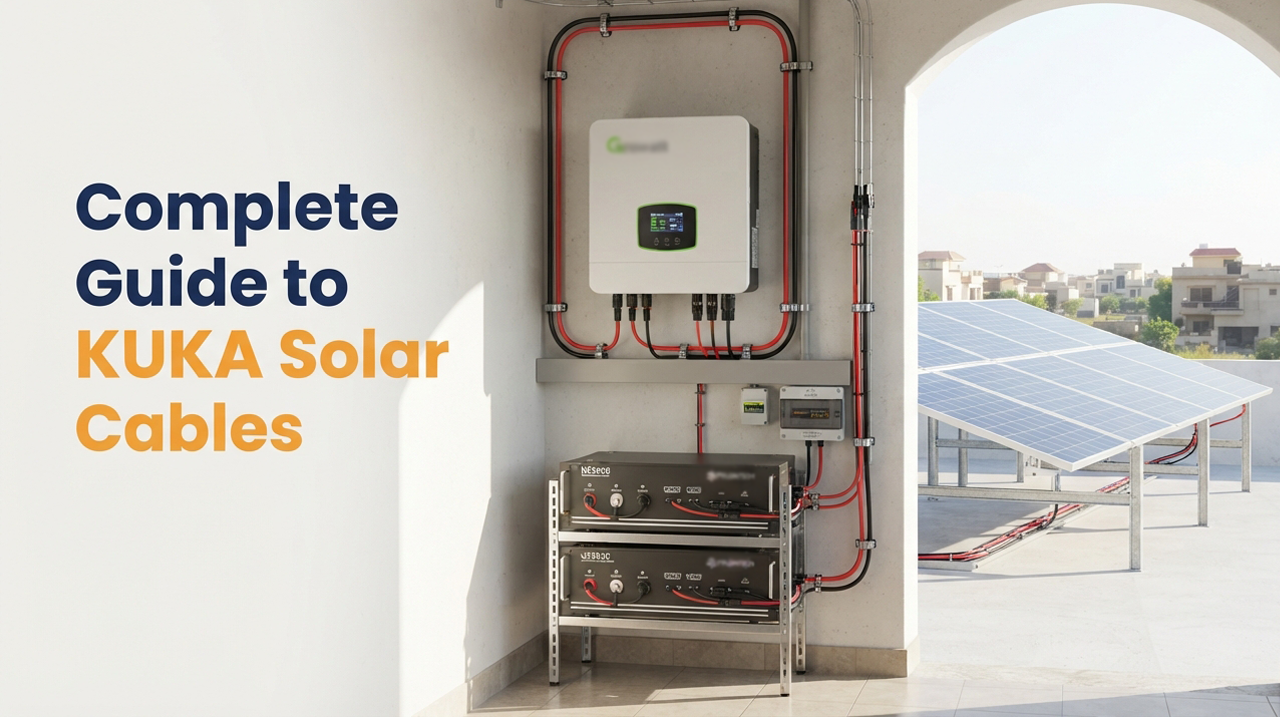
A solar cable, also known as a photovoltaic cable or PV cable, is a specially designed electrical cable used in solar power systems.
Its primary purpose is to transport the DC electricity generated by solar panels between different parts of the PV system.
For example:
Solar Panels ? PV Cables ? DC Protection ? Solar Inverter ? AC Distribution ? Electrical Loads
Solar cables are different from ordinary household electrical wires because they are specifically designed for demanding outdoor environments.
A properly designed PV cable needs to withstand factors such as
- Direct sunlight
- UV radiation
- High temperatures
- Rain and moisture
- Dust
- Mechanical stress
- Voltage fluctuations
- Long-term outdoor exposure
Therefore, selecting the right solar cable is an important part of professional solar system design.
What Is KUKA Solar Cable?
KUKA Solar Cable is a photovoltaic cable designed for solar PV applications.
Energy Alternatives currently lists KUKA Solar Cable in its product portfolio and identifies itself as an authorized distributor. Its published product information includes KUKA 4mm² and 6mm² solar cables, with 1500V DC ratings and XLPO insulation.
The cable is designed for applications where reliable DC power transmission is required between solar modules, string connections, combiner equipment, and inverters.
Depending on the project, cable selection should consider
- Cross-sectional area
- Current carrying capacity
- Voltage
- Cable length
- Ambient temperature
- Installation method
- Voltage drop
- System design
- Connector compatibility
This means choosing a solar cable should not simply be based on the cheapest price per meter.
Why Solar Cable Quality Matters
A solar PV system can operate for decades. Solar panels may remain exposed to the outdoor environment every day for many years, meaning their cables are also continuously exposed to environmental conditions.
Poor-quality cables can potentially result in:
- Excessive voltage drop
- Higher electrical losses
- Insulation degradation
- Overheating
- Connector problems
- Premature cable replacement
- Increased safety risks
A good PV cable is therefore an investment in the overall reliability of the solar system.
It is also important to understand that cable quality alone cannot guarantee system performance. Correct sizing, proper connectors, professional installation, routing, protection, and regular inspection are equally important.
How KUKA Solar Cable Works
Solar panels generate direct current (DC) electricity.
The generated electricity travels through PV cables toward the solar inverter.
A simplified process looks like this:
Step 1: Solar panels generate electricity
Sunlight strikes photovoltaic cells and produces DC electricity.
Step 2: Solar cables transport the DC power
The PV cables connect the solar modules and carry the generated electricity through the DC side of the system.
Step 3: DC power reaches the inverter
The solar inverter receives the DC electricity.
Step 4: The inverter converts DC to AC
The inverter converts DC electricity into AC electricity that can be used by electrical appliances or supplied to the grid, depending on the system configuration.
Step 5: Electricity reaches the loads
The generated energy can then power residential, commercial, or industrial electrical loads.
Because solar cables are part of this energy pathway, their electrical characteristics and installation quality matter.
Key Components of KUKA Solar Cable
A professional solar cable consists of several layers.
Conductor
The conductor carries electrical current.
Energy Alternatives' published KUKA product specifications identify tinned copper, Class 5 conductors for the listed cable sizes.
Tinned copper can provide good conductivity while offering additional protection against corrosion, which is particularly useful in demanding environments.
Insulation
The insulation surrounds the conductor and provides electrical separation and environmental protection.
The KUKA specifications published by Energy Alternatives identify XLPO (cross-linked polyolefin) insulation.
Outer Sheath
The outer layer provides additional protection against environmental exposure and mechanical conditions.
Energy Alternatives describes its listed KUKA cables as UV/weather resistant, with the 6mm² product additionally described as UV and flame retardant.
Cable Markings
Proper PV cables should also carry relevant identification and technical markings, allowing installers and inspectors to verify the cable specification.
KUKA Solar Cable Specifications
According to the current KUKA product information published by Energy Alternatives, the listed cables feature specifications including:
Specification KUKA Solar Cable
Conductor Tinned Copper, Class 5
Insulation XLPO
Voltage Rating 1500V DC / 1.0kV AC
Common Sizes 4mm², 6mm²
UV Resistance Yes
Weather Resistance Yes
Temperature Specification Product-dependent; verify current datasheet
Standards Listed TÜV, IEC 62930, EN 50618
Applications Solar PV installations
Important: Always verify the exact specification and applicable certification against the manufacturer's current datasheet for the particular KUKA cable model before installation, especially for temperature ratings and project-specific compliance.
Types and Sizes of KUKA Solar Cable
Solar cables are available in different cross-sectional areas.
The most appropriate size depends on the electrical design of the system.
Common PV cable sizes include:
- 4mm²
- 6mm²
- 10mm²
- Larger sizes for specialized applications
Energy Alternatives currently highlights KUKA 4mm² and 6mm² cables in its product portfolio.
4mm² KUKA Solar Cable
The 4mm² KUKA Solar Cable is commonly considered for smaller solar installations and suitable DC wiring applications where the calculated current and voltage drop permit its use.
Energy Alternatives describes its 4mm² KUKA cable as a 1500V DC-rated cable with XLPO insulation and tinned copper Class 5 conductor.
Typical applications include:
- Residential rooftop systems
- Small commercial installations
- Panel-to-panel string wiring
- Shorter DC cable runs
- Small offices and shops
However, system size alone should not determine cable selection. Current, cable length, installation conditions, temperature, grouping, and allowable voltage drop should all be considered.
6mm² KUKA Solar Cable
The 6mm² KUKA Solar Cable provides a larger conductor cross-section than 4mm² cable and can be appropriate for applications requiring greater current capacity or longer cable runs, subject to engineering calculations.
Energy Alternatives lists its 6mm² KUKA cable as 1500V DC-rated, with a tinned copper Class 5 conductor and XLPO insulation.
Common applications include:
- Commercial solar installations
- Larger rooftop systems
- Longer DC cable runs
- Schools
- Hospitals
- Agricultural solar systems
- Industrial applications
The exact cable size should always be confirmed by the system designer or qualified installer.
10mm² Solar Cable and Larger Systems
Larger commercial and industrial solar installations can require cables with greater cross-sectional areas.
Energy Alternatives' published KUKA product information also describes a 10mm² KUKA cable for larger commercial and industrial applications.
For large projects, cable selection becomes even more important because cable runs may be considerably longer and system currents significantly higher.
Industrial solar projects may require detailed calculations covering
- Current capacity
- Voltage drop
- Cable routing
- Ambient temperature
- Cable grouping
- DC protection
- Installation method
- Connector specifications
For large projects, professional engineering assessment is strongly recommended.
Where Are KUKA Solar Cables Used?
KUKA Solar Cables can be used in a wide range of photovoltaic applications.
Residential Solar
Homes installing:
- On-grid solar
- Hybrid solar
- Battery-backed systems
can use appropriately sized PV cables for their DC connections.
Commercial Solar
Commercial buildings often require longer cable runs and higher power capacity.
Potential applications include:
- Offices
- Shopping centers
- Schools
- Hospitals
- Hotels
Industrial Solar
Factories and industrial facilities may install hundreds of kilowatts or megawatts of solar capacity.
Proper cable engineering is especially important in these installations.
Agricultural Solar
Solar-powered agricultural systems, including water-pumping applications, can also require durable outdoor PV cabling.
Solar Farms
Utility-scale PV plants require extensive DC cabling between solar modules, strings, combiner systems, and inverters.
Benefits of KUKA Solar Cable
Designed for PV Applications
Solar cables are specifically designed for photovoltaic installations rather than being ordinary electrical wires adapted for outdoor use.
High Voltage Capability
The KUKA cables listed by Energy Alternatives are rated up to 1500V DC, subject to the specific model.
UV Resistance
Solar installations remain exposed to sunlight for years. UV-resistant construction helps the cable withstand prolonged outdoor exposure.
Weather Resistance
PV cables are designed for outdoor environments where they can encounter rain, humidity, dust, and temperature variations.
Tinned Copper Conductor
The listed KUKA cables use tinned copper Class 5 conductors.
Flexible Construction
A flexible conductor can make routing and installation easier, particularly around rooftop solar arrays.
Long-Term Solar Applications
A properly selected and installed PV cable is designed for long-term service in solar installations.
KUKA Cable vs Ordinary Electrical Cable
One of the most common mistakes when installing solar systems is assuming that any electrical cable can be used for solar DC connections.
That is not necessarily the case.
Feature PV Solar Cable Ordinary Electrical Cable
Designed for PV systems Yes Not necessarily
Outdoor solar application Yes Product-dependent
UV resistance Designed for PV exposure Product-dependent
High DC voltage applications Yes, depending on rating Product-dependent
Solar-specific standards Yes, depending on product Not necessarily
Long-term outdoor exposure Designed for this application Product-dependent
The correct cable must be selected based on the system design and applicable electrical standards.
How to Choose the Right Solar Cable Size
Choosing the right cable isn't simply about choosing the largest or cheapest option.
Several factors should be considered.
System Current
The cable must safely carry the expected current.
Cable Length
Longer cable runs can increase voltage drop.
Voltage
The cable's voltage rating must be suitable for the PV system.
Temperature
High ambient temperatures can affect cable ampacity.
Installation Method
Cables installed in different environments may have different thermal conditions.
Cable Grouping
Multiple cables installed together can affect heat dissipation.
Voltage Drop
Cable sizing should consider acceptable voltage drop to avoid unnecessary energy losses.
Project Standards
Commercial and industrial projects may have specific engineering and compliance requirements.
Best practice: Have the cable size calculated by a qualified solar engineer or installer rather than selecting a size solely based on system kW.
KUKA Solar Cable Installation Process
Professional installation is essential for achieving reliable performance.
Step 1: System Assessment
Determine:
- PV system capacity
- String configuration
- Inverter specifications
- Cable routes
- Approximate cable lengths
Step 2: Cable Sizing
Calculate the required conductor cross-section based on current, distance, voltage drop, temperature, and installation conditions.
Step 3: Cable Routing
Plan routes that minimize:
- Excessive cable length
- Sharp bends
- Mechanical damage
- Unnecessary exposure
Step 4: Connector Installation
Use compatible and properly rated PV connectors.
Poor crimping or incompatible connectors can create resistance and heat.
Step 5: Cable Securing
Cables should be securely supported and routed to reduce mechanical stress.
Step 6: Protection
Where required, use appropriate conduits, cable trays, clips, protection devices, and other installation measures.
Step 7: Testing
Before commissioning, the installation should undergo appropriate electrical and safety testing by qualified personnel.
Common Solar Cable Installation Mistakes
Even premium cable can perform poorly if incorrectly installed.
Avoid:
Using an Undersized Cable
An undersized conductor can increase losses and heating.
Mixing Incompatible Connectors
Connectors should be compatible and properly rated.
Leaving Cables Loose
Loose cables can experience mechanical movement and abrasion.
Excessive Cable Loops
Unnecessary cable length increases material use and can complicate installation.
Poor Cable Routing
Cables should be routed and secured according to the installation design.
Ignoring Voltage Drop
Long cable runs require voltage-drop calculations.
Using Counterfeit Products
Counterfeit products may not meet the claimed technical specifications.
KUKA Solar Cable Price in Pakistan
The price of KUKA Solar Cable in Pakistan can change due to several market factors, including:
- Copper prices
- Currency exchange rates
- Import costs
- Product specifications
- Cable size
- Order quantity
- Market conditions
Energy Alternatives currently lists KUKA cable products in its online store, including a 6mm² 100m roll and a 4mm² 100m roll. The displayed online-store prices may change, so customers should confirm the latest price and stock before ordering.
For bulk projects, EPC contractors, installers, and commercial customers, requesting a project-specific quotation can be more appropriate than relying on a general per-meter price.
Why Buy KUKA Cable from Energy Alternatives?
Selecting the cable brand is only part of the purchasing decision. The source of the product also matters.
Energy Alternatives positions itself as an authorized distributor of KUKA Cable in Pakistan and provides KUKA products as part of its renewable energy portfolio.
Why customers can choose Energy Alternatives:
Authorized Distribution
Energy Alternatives identifies KUKA Cable as an authorized-distributor product.
Product Availability
The company currently lists KUKA 4mm² and 6mm² cables in its product portfolio.
Technical Guidance
Customers can discuss cable sizing and project requirements with the Energy Alternatives team.
Residential to Industrial Supply
The company serves residential, commercial, and industrial renewable energy projects.
Renewable Energy Expertise
Energy Alternatives' wider portfolio includes solar systems, solar panels, solar inverters, EV charging, biomass, and solar thermal solutions.
Nationwide Reach
Energy Alternatives states that it serves customers across Pakistan and currently lists Lahore as its head-office location.
Challenges When Buying Solar Cables in Pakistan
Pakistan's rapidly expanding solar market has created significant demand for PV products. However, buyers should remain careful when purchasing solar cables.
Counterfeit Products
Products with misleading specifications can be found in unregulated markets.
Incorrect Cable Sizing
A cable may be genuine but still unsuitable if the wrong size is selected.
Price-Based Purchasing
The cheapest cable is not necessarily the best value.
Unverified Specifications
Always check:
- Cable size
- Voltage rating
- Insulation
- Conductor material
- Applicable standards
- Manufacturer markings
Poor Installation
Even a premium cable can fail prematurely if installed incorrectly.
This is why buying from an established distributor and obtaining technical guidance can make a significant difference.
Frequently Asked Questions About KUKA Solar Cable
Is KUKA Solar Cable suitable for solar panels?
Yes. KUKA Solar Cable is designed for photovoltaic applications and is intended for DC-side solar system wiring.
What sizes of KUKA Solar Cable are available?
Energy Alternatives currently highlights 4mm² and 6mm² KUKA Solar Cables, with additional product information available for 10mm² applications.
What is the voltage rating of KUKA Solar Cable?
The KUKA cables listed by Energy Alternatives are rated at 1500V DC / 1.0kV AC, subject to the exact product specification.
Is KUKA Cable UV resistant?
Yes. Energy Alternatives lists UV resistance among the features of its KUKA Solar Cable products.
Is KUKA Solar Cable suitable for Pakistan's climate?
PV cables are designed for outdoor environments, and KUKA's listed products include UV and weather-resistant construction. However, installation conditions and the exact product temperature specification should always be checked before deployment.
What is the difference between 4mm² and 6mm² KUKA Cable?
The main difference is the conductor cross-sectional area. A 6mm² cable has a larger conductor and can be suitable for higher current or longer runs where engineering calculations require it.
Can KUKA Cable be used for industrial solar projects?
Yes, appropriately sized KUKA PV cables can be used in commercial and industrial PV applications, subject to project design and electrical requirements.
Where can I buy genuine KUKA Solar Cable in Pakistan?
Energy Alternatives offers KUKA Solar Cable as an authorized-distributor product and provides supply and technical support for solar projects.
Does Energy Alternatives provide solar solutions besides KUKA Cable?
Yes. Energy Alternatives provides solar EPC solutions, solar panels, solar inverters, EV charging solutions, biomass energy, and solar thermal solutions.
Can I get a quotation for a large solar project?
Yes. Project owners, EPC contractors, installers, businesses, and industrial customers can contact Energy Alternatives for product availability, technical guidance, and project quotations.
Why KUKA Solar Cable Is an Important Part of Your Solar Investment
A solar system is made up of many interconnected components. Solar panels may generate the electricity, and the inverter converts it into usable AC power, but the cables are responsible for safely transporting that energy between the system components.
That makes solar cable selection an important engineering decision.
A good PV cable should be:
- Correctly sized
- Properly rated
- Suitable for outdoor exposure
- Compatible with the system
- Correctly installed
- Purchased from a reliable source
KUKA Solar Cable offers a PV-specific solution with features such as tinned copper conductors, XLPO insulation, UV/weather-resistant construction, and 1500V DC ratings on the products listed by Energy Alternatives.
Choose Energy Alternatives for KUKA Solar Cable in Pakistan
If you're looking for KUKA Solar Cable in Pakistan, Energy Alternatives provides an authorized-distribution channel along with renewable energy expertise and technical support.
Whether you're installing a residential rooftop system, a commercial solar plant, or a large industrial project, the right cable should be selected according to your actual electrical requirements—not simply according to price.
Energy Alternatives can help customers and solar professionals identify suitable KUKA cable options for their projects and source the required products.
Looking for genuine KUKA Solar Cable?
Get in touch with Energy Alternatives for
- KUKA 4mm² Solar Cable
- KUKA 6mm² Solar Cable
- Project and bulk requirements
- Cable sizing guidance
- Solar EPC requirements
- Commercial and industrial supply
- Product availability and quotations
Final Takeaway
Choosing the right solar cable is an essential part of building a safe, efficient, and reliable solar energy system.
KUKA Solar Cable is designed specifically for photovoltaic applications and, according to Energy Alternatives' current product information, offers features including tinned copper conductors, XLPO insulation, UV/weather resistance, and 1500V DC-rated configurations.
However, the best cable isn't determined by brand alone. Correct sizing, proper installation, compatible connectors, suitable protection, and professional engineering are equally important.
For customers in Pakistan, purchasing through an authorized distributor can also help reduce the risk of receiving incorrectly specified or counterfeit products.
With KUKA Cable and its broader portfolio of solar, EV charging, biomass, and solar thermal solutions, Energy Alternatives aims to provide a complete renewable energy ecosystem for customers across Pakistan.