Solar energy has rapidly become one of the most practical renewable energy solutions for homes, businesses, industries, agricultural facilities, and institutions across Pakistan. With rising electricity costs, increasing demand for reliable power, and abundant sunlight throughout much of the country, solar power offers an opportunity to generate clean electricity while reducing dependence on conventional energy sources.
But how does a solar system actually work?
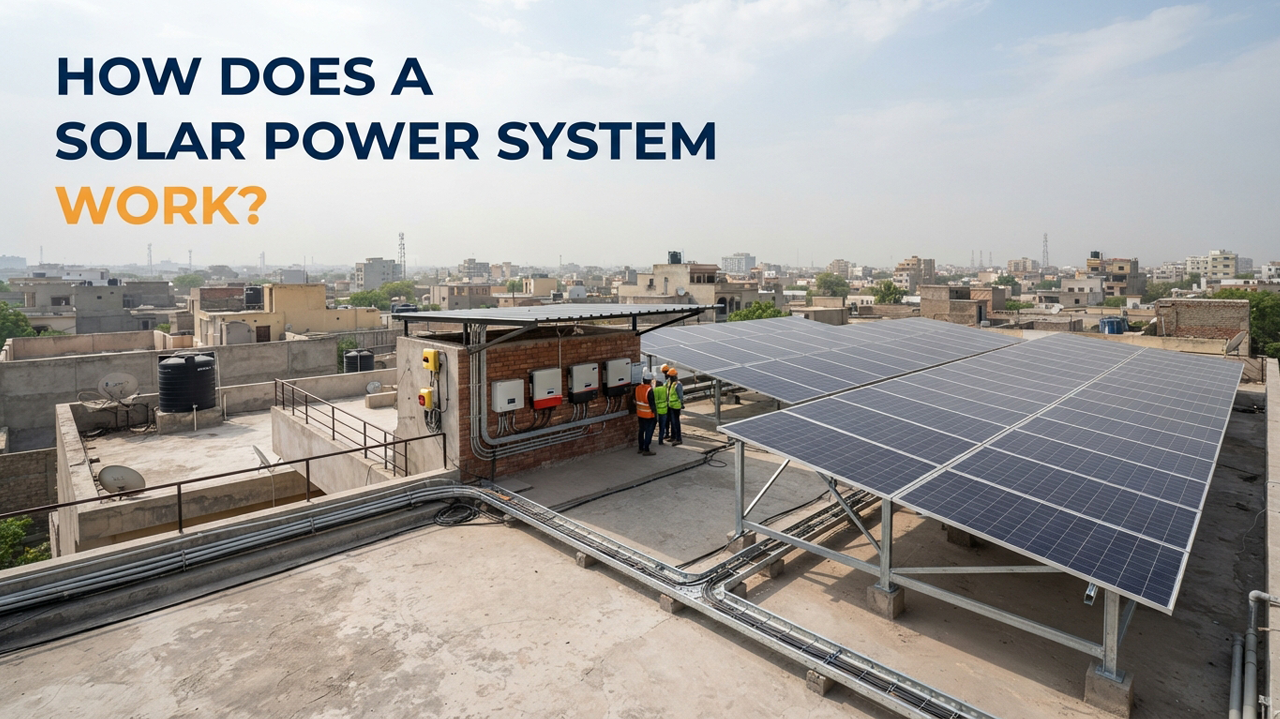
A solar system may look simple from the outside—solar panels installed on a rooftop, an inverter mounted nearby, and cables connecting everything together—but several components work together to convert sunlight into usable electricity.
In this guide, we explain how a solar system works, its major components, the different types of solar systems, how electricity flows from sunlight to your appliances, and why professional system design matters.
What Is a Solar Energy System?
A solar energy system is a combination of equipment designed to capture energy from sunlight and convert it into usable electrical or thermal energy.
For electricity generation, a typical photovoltaic (PV) solar system includes
- Solar panels
- Solar inverter
- Solar cables
- Mounting structures
- Protection and switching equipment
- Monitoring system
- Batteries, where applicable
- Grid connection, in an on-grid system
The solar panels capture sunlight and produce direct current (DC) electricity. The inverter then converts this DC electricity into alternating current (AC), which can be used by conventional electrical appliances.
Depending on the system configuration, excess electricity may be stored in batteries or exported to the electricity grid.
How Does a Solar System Work?
The basic process can be summarized in six steps:
Sunlight ? Solar Panels ? DC Electricity ? Inverter ? AC Electricity ? Appliances / Battery / Grid
Let's look at each stage in detail.
Solar Panels Capture Sunlight
The process starts when sunlight reaches the solar panels.
Solar panels contain photovoltaic cells, generally made using semiconductor materials such as silicon. When sunlight strikes these cells, photons transfer energy to electrons within the semiconductor material.
This movement of electrons creates an electrical current.
The electricity produced by the panels is DC electricity.
The amount of electricity generated depends on several factors, including:
- Solar irradiance
- Panel efficiency
- Panel orientation
- Tilt angle
- Temperature
- Shading
- Dust and dirt
- System design
- Cable losses
This is why proper solar panel positioning and professional system design are important for achieving good performance.
DC Electricity Travels Through Solar Cables
Once the solar panels generate electricity, the DC power travels through specially designed photovoltaic cables.
This is where solar cables such as KUKA Cable play an important role.
Solar cables are designed specifically for outdoor photovoltaic applications and are built to withstand conditions such as:
- UV exposure
- High temperatures
- Humidity
- Rain
- Dust
- Mechanical stress
The correct cable size must be selected according to the system's current, voltage, cable length, installation conditions, and allowable voltage drop.
Using inappropriate or low-quality cables can increase electrical losses and create unnecessary safety risks.
For large solar installations, cable selection becomes particularly important because even small losses can accumulate over thousands of operating hours.
The Inverter Converts DC Into AC
Solar panels produce DC electricity, while most household, commercial, and industrial electrical equipment operates using AC electricity.
This is where the solar inverter comes in.
The inverter converts the DC electricity generated by the solar panels into AC electricity suitable for the property's electrical system.
Modern inverters do much more than simply convert electricity.
Depending on the model, an inverter may also provide
- System monitoring
- Maximum Power Point Tracking (MPPT)
- Grid synchronization
- Protection functions
- Fault detection
- Energy production data
- Battery management
- Remote monitoring
The inverter is therefore one of the most important components of a modern solar power system.
Electricity Powers Your Loads
After conversion, AC electricity can be supplied to the building's electrical loads.
These may include:
Residential Loads
- Lights
- Fans
- Refrigerators
- Air conditioners
- Washing machines
- Water pumps
- Televisions
- Computers
Commercial Loads
- Lighting systems
- HVAC systems
- Office equipment
- Elevators
- Pumps
- IT equipment
Industrial Loads
- Motors
- Machinery
- Pumps
- Compressors
- Production equipment
- Industrial HVAC systems
During daylight hours, solar energy can therefore directly offset electricity that would otherwise need to be purchased from the grid.
What Happens to Excess Solar Electricity?
What happens when your solar panels generate more electricity than your building is consuming?
The answer depends on the type of solar system.
In an on-grid system, excess electricity can potentially be exported to the electricity grid under the applicable grid-interconnection/net-metering arrangements.
In a hybrid system, excess electricity may be used to charge batteries before being exported or curtailed, depending on system configuration and applicable settings.
In an off-grid system, excess generation can generally be directed toward battery charging or other configured loads because the system is designed to operate independently of the utility grid.
Batteries Store Solar Energy
Batteries are not required in every solar system.
They are primarily used when energy storage is desired.
During periods when solar generation exceeds the property's immediate demand, surplus electricity can be used to charge the battery.
Later, when solar generation decreases, stored energy can be supplied to the loads.
This can be particularly useful for:
- Nighttime electricity usage
- Backup power
- Areas with unreliable grid supply
- Critical loads
- Energy management strategies
Modern systems may use lithium-ion battery technologies because of their energy density, efficiency, and cycle-life characteristics.
The Main Components of a Solar System
Understanding the individual components makes it easier to understand how the complete system operates.
Solar Panels
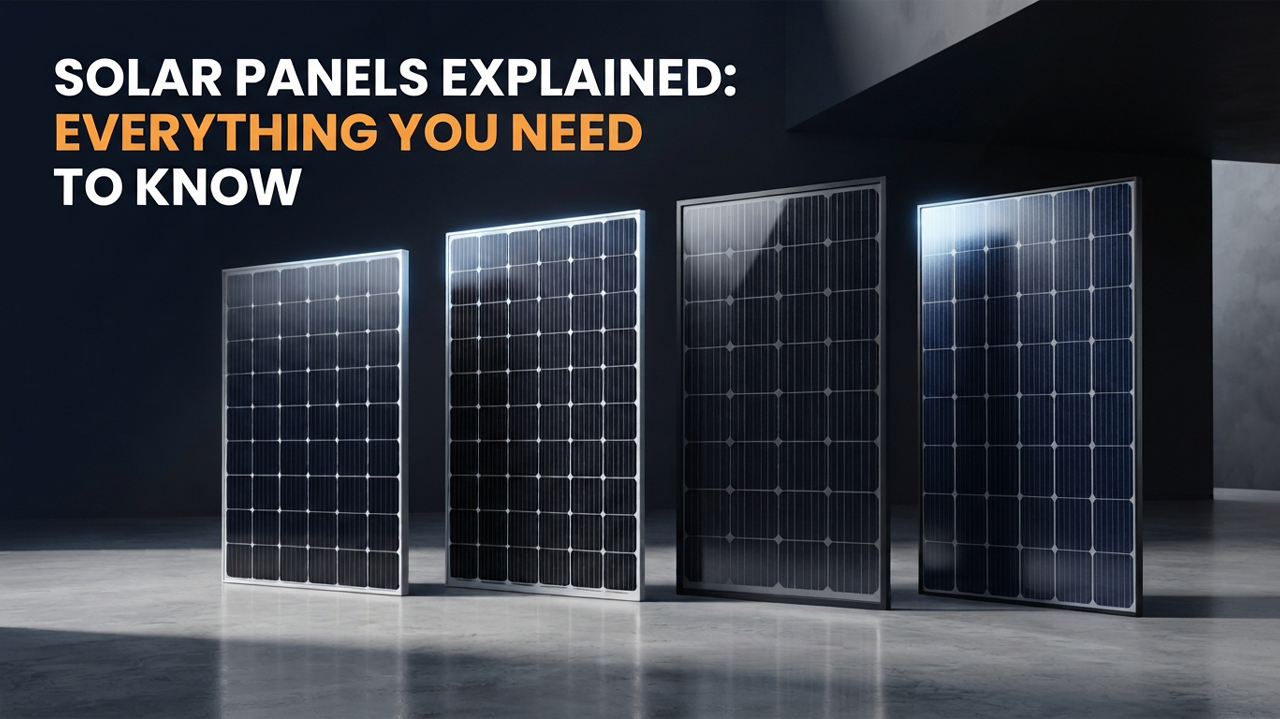
Solar panels are the primary energy-generation component.
They convert sunlight into DC electricity.
Modern solar modules are available in different technologies and configurations, including:
- Monocrystalline panels
- Bifacial panels
- N-type modules
- High-efficiency modules
The appropriate panel depends on the project's available area, energy requirements, budget, environmental conditions, and design objectives.
Solar Inverter
The inverter converts DC power into AC power.
There are several inverter configurations, including:
- String inverters
- Hybrid inverters
- Central inverters
- Microinverters
The right inverter depends on system size, architecture, battery requirements, shading conditions, monitoring requirements, and other project considerations.
Solar Cables
Solar cables connect the various components of the PV system.
They are particularly important because they carry electrical power between
Solar panels ? Combiner/protection equipment ? Inverter
Depending on system architecture, additional cables connect the inverter to batteries, distribution equipment, and other components.
Energy Alternatives provides KUKA Cable as part of its renewable energy product range.
Mounting Structure
Solar panels need a secure structure that keeps them correctly positioned.
Mounting structures may be installed on:
- Rooftops
- Ground-mounted systems
- Industrial buildings
- Commercial buildings
- Solar farms
- Carports
A properly engineered structure must account for wind loading, panel configuration, roof conditions, corrosion considerations, and installation requirements.
Protection Equipment
Solar systems require appropriate electrical protection.
Depending on the system, this may include
- DC isolators
- AC circuit breakers
- DC protection
- Surge protection devices
- Earthing/grounding systems
- Distribution equipment
Protection systems help reduce the risk associated with electrical faults, surges, and abnormal operating conditions.
Monitoring System
Modern solar systems can provide real-time performance information.
Monitoring platforms may show:
- Current power generation
- Daily generation
- Monthly generation
- Historical production
- Energy consumption
- Battery status
- System faults
This helps system owners and operators identify potential performance issues and understand their energy production.
Types of Solar Systems
Solar systems can generally be divided into three major categories.
On-Grid Solar System
An on-grid solar system is connected to the utility electricity network.
During daylight hours, solar electricity can supply the property's loads.
If solar generation is insufficient, electricity can be drawn from the grid.
If generation exceeds consumption, eligible systems may export surplus electricity to the grid according to the applicable interconnection arrangement.
Advantages
- Can reduce electricity purchases
- No battery required in a basic configuration
- High daytime utilization
- Suitable for homes and businesses
Suitable For
- Homes
- Offices
- Shops
- Commercial buildings
- Factories
Off-Grid Solar System
An off-grid system operates independently of the utility grid.
It normally requires batteries or another energy-storage solution to provide electricity when solar generation is unavailable.
Advantages
- Independent from the utility grid
- Useful in remote areas
- Can provide electricity where grid access is unavailable
Suitable For
- Remote locations
- Agricultural applications
- Rural facilities
- Telecom installations
- Remote businesses
Hybrid Solar System
A hybrid system combines solar generation with energy storage and, where applicable, grid electricity.
During the day, solar energy can supply loads and charge the battery.
When solar generation is insufficient, the system can use stored energy and/or grid electricity depending on its configuration and settings.
Advantages
- Energy storage
- Backup capability
- Flexible energy management
- Greater control over energy usage
Suitable For
- Homes requiring backup
- Commercial facilities
- Offices
- Critical-load applications
- Businesses seeking greater energy flexibility
What Happens on a Cloudy Day?
Solar panels do not stop working simply because the sky is cloudy.
They can still generate electricity from available sunlight, although production may be lower than on a clear day.
Solar generation varies throughout the day according to
- Solar irradiance
- Cloud cover
- Temperature
- Panel orientation
- Shading
This is one reason why a properly designed solar system should consider the property's energy consumption profile rather than simply selecting panels based on maximum possible output.
Does Solar Work at Night?
Solar panels require sunlight to generate electricity, so they do not generate power at night.
However, a solar-powered property can still use electricity at night through:
Grid-connected systems
Electricity can be supplied by the utility grid when solar generation is unavailable.
Battery systems
Stored solar energy can be used to supply loads.
This makes battery storage particularly useful for customers who want to use more of their solar energy outside daylight hours.
How Much Electricity Can a Solar System Generate?
Solar generation depends on numerous factors, so there is no single output figure for every system.
For example, two systems with the same installed panel capacity may generate different amounts of electricity because of differences in:
- Location
- Solar irradiation
- Panel orientation
- Tilt angle
- Shading
- Temperature
- Equipment efficiency
- System losses
- Maintenance
For this reason, professional solar companies should evaluate the site and energy consumption before recommending system capacity.
Why Solar System Design Matters
Installing solar panels is not simply a matter of putting a certain number of panels on a roof.
A properly engineered system considers the entire energy chain.
Energy Generation
How much solar energy can the site realistically produce?
Energy Consumption
When and how much electricity does the customer consume?
Equipment Selection
Which panels, inverter, cables, structures, and protection equipment are appropriate?
Electrical Design
Are voltage, current, protection, and cable requirements correctly calculated?
Structural Design
Can the roof or ground structure safely support the PV system?
Future Requirements
Will the customer add more loads, batteries, EV chargers, or other equipment later?
Professional design helps optimize system performance, safety, reliability, and long-term value.
Solar Energy for Homes in Pakistan
Residential solar systems are increasingly being considered by Pakistani homeowners seeking to manage electricity costs and improve energy resilience.
A typical home system may include:
Solar Panels ? Solar Inverter ? Home Distribution System
A hybrid system may add:
Battery Storage
The ideal configuration depends on the household's:
- Monthly electricity consumption
- Peak load
- Daytime consumption
- Backup requirements
- Available roof space
- Budget
Solar Enrgy for Commercial & Industrial Businesses
Commercial and industrial facilities can have significant daytime electricity consumption.
This can make solar particularly attractive because the period of highest solar generation often overlaps with business operating hours.
Applications include:
- Manufacturing plants
- Textile factories
- Warehouses
- Shopping centers
- Offices
- Schools
- Hospitals
- Hotels
- Agricultural facilities
Large systems require detailed engineering because electrical loads, transformer capacity, protection systems, roof structures, and operational requirements can be considerably more complex than residential installations.
Solar and EV Charging: The Next Step in Clean Energy
The relationship between solar energy and electric mobility is becoming increasingly important.
A solar system can be integrated with an EV charging station to provide renewable electricity for electric vehicles.
A simplified energy flow could be:
Sunlight ? Solar Panels ? Inverter ? EV Charger ? Electric Vehicle
Depending on system design, battery storage can also be incorporated.
This creates an integrated clean-energy ecosystem combining
- Solar generation
- Energy storage
- Electric mobility
For businesses, commercial properties, offices, hotels, and housing developments, solar-powered EV charging can become an important component of future energy infrastructure.
Solar System Maintenance
Solar systems generally require relatively low maintenance, but regular inspection is still important.
Recommended activities may include:
Panel Cleaning
Dust and dirt can reduce the amount of sunlight reaching the photovoltaic cells.
Electrical Inspection
Check cables, connectors, protection equipment, and electrical connections.
Inverter Monitoring
Review system performance and fault notifications.
Structural Inspection
Check mounting structures for corrosion, loose components, or other issues.
Performance Monitoring
Compare actual generation against expected system performance.
Regular maintenance can help identify problems before they become major failures.
Common Problems That Can Reduce Solar Performance
Several issues can affect system output.
Shading
Trees, buildings, walls, or other objects can reduce solar generation.
Dust
Accumulated dust can reduce sunlight reaching the panels.
Incorrect System Sizing
An incorrectly sized system may not meet the customer's energy objectives.
Poor Cable Selection
Undersized or unsuitable cables can increase electrical losses and create safety concerns.
Inverter Problems
Faults or incorrect configuration can affect system operation.
Poor Installation
Incorrect panel positioning, weak mounting, or poor electrical connections can reduce reliability.
This is why choosing an experienced solar engineering and installation partner is important.
Why Choose Energy Alternatives for Solar Solutions in Pakistan?
Energy Alternatives provides renewable energy solutions designed around the specific requirements of its customers.
Our renewable energy portfolio includes:
Solar Energy
Complete solar solutions for residential, commercial, and industrial applications.
Solar Panels
High-quality photovoltaic modules for different project requirements.
Solar Inverters
Inverter solutions designed to convert and manage solar electricity.
KUKA Solar Cable
Solar-grade cabling for reliable electrical energy transmission within PV systems.
EV Charging Solutions
Charging infrastructure for electric mobility applications.
Solar Thermal
Solutions that use solar energy for thermal applications such as water heating and other heat requirements.
Biomass
Renewable energy solutions utilizing organic materials as an energy resource.
By combining products, engineering, installation, and renewable energy expertise, Energy Alternatives aims to help customers transition toward cleaner and more efficient energy systems.
Frequently Asked Questions
How does a solar system generate electricity?
Solar panels convert sunlight into DC electricity through photovoltaic cells. An inverter then converts the DC electricity into AC electricity that can be used by electrical appliances.
Does a solar system work during cloudy weather?
Yes. Solar panels can generate electricity from available sunlight, although their output may be lower than under clear conditions.
Does solar work at night?
Solar panels do not generate electricity without sunlight. At night, electricity can come from the grid or battery storage depending on the system configuration.
Do I need batteries with solar panels?
Not necessarily. On-grid systems can operate without batteries. Batteries are generally added when energy storage or backup capability is required.
How long does a solar system last?
Solar panels are generally designed for long-term operation, often with performance warranties extending for decades. Other components, such as inverters and batteries, may have different expected service lives.
Are solar cables important?
Yes. Solar cables are responsible for safely transmitting DC electricity between system components. Proper cable sizing and quality are important for efficiency and safety.
Can solar power an EV charger?
Yes. Solar systems can be integrated with EV charging infrastructure, subject to appropriate system sizing and electrical design.
Conclusion: Turning Sunlight Into Usable Energy
So, how does a solar system work?
The principle is straightforward:
Sunlight reaches the solar panels.
The panels convert sunlight into DC electricity.
Solar cables safely transport the electricity through the system.
The inverter converts DC into AC electricity.
The electricity is then used to power appliances, equipment, businesses, and other loads.
Depending on the system configuration, surplus electricity can be stored in batteries or exported to the grid under applicable arrangements.
However, the real value of a solar system comes from designing all these components to work together efficiently.
For customers in Pakistan, choosing the right combination of solar panels, inverter, solar cables, mounting structures, protection equipment, and monitoring systems is essential for achieving reliable long-term performance.
Energy Alternatives provides renewable energy solutions across solar energy, EV charging, KUKA Cable, solar thermal, and biomass applications—helping homes, businesses, and industries move toward a cleaner and more sustainable energy future.